
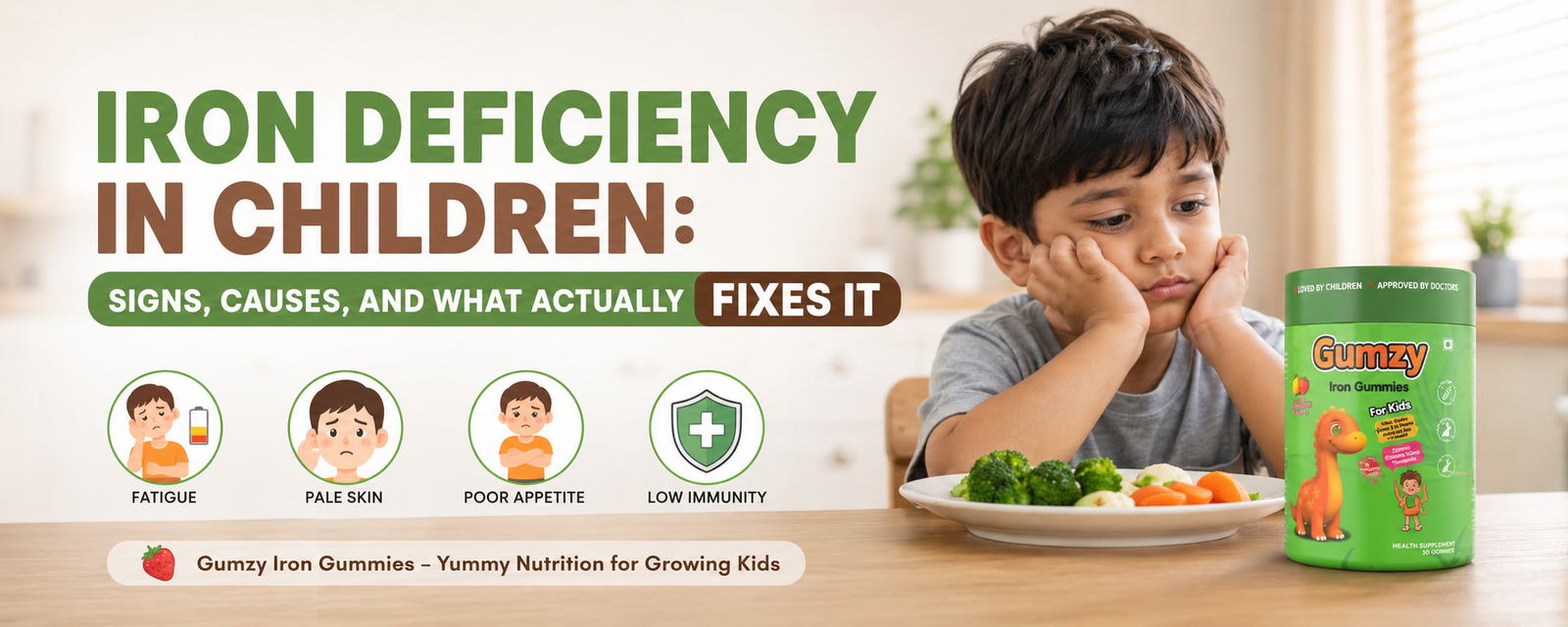
Iron Deficiency in Children: Signs, Causes, and What Actually Fixes It
If you picked one nutrition problem to understand properly as an Indian parent, make it this one. Iron deficiency is the most widespread micronutrient problem in the country: national family health surveys have found well over half of young Indian children anaemic [cite NFHS-5]. Not a rare condition closer to a coin flip.
And yet it hides in plain sight, because its symptoms tiredness, paleness, poor focus get blamed on screens, weather, school stress, anything but blood. This guide covers the whole journey: what iron does, how deficiency looks at each age, why it happens (including one cause that will surprise you), how testing works, and the honest hierarchy of fixes from kitchen to supplement.
How Common It Really Is in India (NFHS Data)
NFHS-5 reported anaemia in roughly two-thirds of children aged 6–59 months, and iron deficiency is its leading cause. Crucially, this is not a poverty-only statistic well-fed, urban, middle-class children appear in these numbers in large proportions, because the causes (covered below) are dietary patterns, not food scarcity. Assume your child could be in the affected half until a test says otherwise; that mindset alone puts you ahead of most households.
What Iron Does: Hemoglobin → Oxygen → Energy → Brain
Iron’s core job is haemoglobin the protein in red blood cells that picks up oxygen in the lungs and delivers it everywhere else. Less iron means less haemoglobin means less oxygen reaching muscles and, critically, the brain. That single supply-chain failure explains every classic symptom: tired muscles, pale skin, a foggy and inattentive mind.
In children there’s a second, time-sensitive job: brain development itself uses iron to build neural connections and produce dopamine. This is why paediatricians treat childhood iron deficiency with urgency — prolonged deficiency during developmental windows can affect learning in ways that outlast the deficiency itself [cite].
8 Symptoms by Age Group
- Babies & toddlers (6 months–3 years): unusual fussiness; pale skin and inner eyelids; delayed milestones; pica — the strange urge to eat mud, chalk, paper or ice, which is a surprisingly specific iron-deficiency clue.
- Preschool & school-age (3–10): fatigue that ends games early; breathlessness on stairs; frequent infections; poor concentration flagged by teachers.
- Tweens & teens: declining stamina or grades; brittle nails (sometimes spoon-shaped); cold hands and feet; in menstruating girls, deficiency risk rises sharply and deserves proactive testing.
Many of these overlap with other gaps — cross-check with our 10-sign deficiency checklist [LINK TO POST #2] to read the overall pattern.
Why It Happens: Diet, Milk Overload, Growth Spurts, Worms
- The vegetarian iron gap. Plant (non-heme) iron from dals and greens is genuinely there but poorly absorbed — typically only a few percent of it makes it into blood, versus far higher rates from meat. The thali isn’t empty of iron; it’s inefficient at delivering it.
- Milk overload — the surprise villain. Milk is nearly iron-free, its calcium actively blocks iron absorption, and a child filling up on 3–4 glasses a day has no appetite left for iron-rich food. Paediatricians see this pattern constantly in toddlers: the well-fed, milk-loving, anaemic child. More than ~500 ml a day deserves a rethink.
- Growth spurts. Blood volume expands fast in toddlerhood and adolescence; iron demand spikes and quietly outruns a usual diet.
- Intestinal worms. Hookworm and similar parasites cause slow blood (and therefore iron) loss. India’s school deworming programme exists precisely for this reason — keep your child’s deworming schedule current.
Getting Tested: Hb vs Ferritin
Two numbers tell the story. Haemoglobin (Hb) is the headline broadly, below about 11 g/dL flags anaemia in young children [cite WHO cutoffs]. Ferritin measures the iron warehouse, and it’s the smarter early-warning test: stores drain long before haemoglobin falls, so a child can have normal Hb and an empty warehouse — “iron deficiency without anaemia” already affecting energy and focus. If you test only Hb, you can miss the early stage entirely. Both tests are routine and inexpensive at Indian labs; ask for both.
Food First: Building an Iron-Rich Plate
Diet is the foundation of both prevention and mild correction. The headlines: ragi, dals and legumes, til and jaggery (in moderation), green leafy vegetables prepared smartly, and the real multiplier vitamin C alongside every iron meal, because a squeeze of lemon can multiply plant-iron absorption severalfold. Equally important is keeping blockers (milk, tea) away from iron meals. We’ve ranked the practical options in 15 iron-rich Indian foods kids will actually eat, and the timing tricks live in our iron absorption guide.
When Supplements Are Needed
Food can prevent deficiency and repair mild gaps, but here’s the honest arithmetic: once stores are properly depleted, food alone refills them painfully slowly. For tested deficiency, paediatricians prescribe therapeutic iron typically for around three months and that prescription should be followed exactly, including after symptoms improve, because stopping early leaves the warehouse half-stocked and invites relapse.
For the maintenance zone borderline ferritin, picky eaters, vegetarian diets, growth spurts gentler daily supplementation makes sense, and format decides whether it actually happens. Iron syrups are notorious: metallic taste, stained teeth, daily protests. A pleasant-tasting iron gummy for kids removes the compliance battle entirely, which over months is what determines success. (We compare formats honestly in iron gummies vs syrups vs tablets.
Forms of Iron Compared (and Tolerability)
Not all supplemental iron behaves the same. Ferrous sulfate, the old default, is cheap and effective but hard on small stomachs constipation, nausea and the famous metallic taste drive abandonment. Gentler chelated forms such as iron bisglycinate absorb well at lower doses with far fewer stomach complaints, making them better suited to children’s daily-maintenance products. Whatever the form, pairing with vitamin C and keeping doses child-appropriate matters more than brand names.
Safety: Why Iron Must Be Kept Away From Children
This section is non-negotiable. Accidental iron overdose is one of the leading causes of poisoning deaths in young children worldwide a handful of adult iron tablets can be fatal to a toddler, and child-friendly flavours raise the temptation. House rules: every iron product stored locked or genuinely out of reach; never call any supplement “sweets” or “candy”; dosing done by an adult, every time. If a child ever consumes multiple doses, treat it as an emergency and seek medical help immediately.
When to See a Doctor Urgently
Book a prompt appointment skip the home-remedy phase for: extreme lethargy or breathlessness at rest, fainting, a racing heartbeat, pica that’s persistent, or pallor that’s worsening week over week. And treat every diagnosed deficiency with follow-up testing after ~3 months; the goal is a refilled warehouse, not just a better-looking child.
Frequently Asked Questions
What hemoglobin level is low for a child?
Broad WHO-based cutoffs: below about 11 g/dL for ages 6 months–5 years, and below roughly 11.5 g/dL for ages 5–11 flags anaemia. Your lab report’s age-specific range and your paediatrician’s reading of it take precedence over any blog’s numbers — including ours.
Can too much milk cause iron deficiency?
Yes — it’s one of the most common causes paediatricians see in toddlers. Milk contains almost no iron, its calcium blocks iron absorption from other foods, and high milk intake crowds out iron-rich meals. Keeping milk to roughly 400–500 ml a day and away from main meals solves most of it.
How long until iron levels improve?
Energy and mood often lift within 2–4 weeks of consistent treatment, haemoglobin typically normalises in 1–2 months, but refilling ferritin stores takes around 3 months. This is why finishing the full course matters even when your child seems fine.
Do iron supplements cause constipation in kids?
Traditional ferrous sulfate often does it’s the top reason families quit. Gentler chelated forms (like iron bisglycinate), smaller consistent doses, adequate water and fibre largely prevent it. If constipation persists, ask your doctor about switching forms rather than stopping iron.
The Bottom Line
Iron deficiency is the most common, most consequential and most fixable nutrition problem in Indian childhood. The playbook: suspect it early (fatigue, pallor, poor focus), test both Hb and ferritin, fix the plate with absorption-smart meals, supplement gently for maintenance or medically for diagnosed deficiency and store every iron product like the serious medicine it is.
Make daily iron the easy part. Gumzy’s Kids Iron Gummies deliver gentle, child-appropriate iron in a taste kids accept on day one and day ninety no metallic taste, no syrup battles. Shop Now






Add comment