

How to Get a Picky Eater to Try New Foods: A Practical Guide for Parents
How to Get a Picky Eater to Try New Foods: A Practical Guide for Parents
Getting a child to try a new food can sometimes feel like a daily challenge. One day they may happily eat a particular vegetable, and the next day they may refuse to even look at it. So, the biggest source of concern for parents is “how to get picky eater to try new foods”?
For parents, this can raise understandable concerns:
“Is my child eating enough?”
“How can I introduce healthier foods?”
“Should I insist that they take a bite?”
Typical feeding behaviors, such as temporary food fads and mild pickiness, are normal developmental phases that do not negatively impact a child’s overall growth. In contrast, problematic feeding involves extreme rigidity, severe food refusal, and distressing mealtimes that often lead to poor weight gain and nutritional deficiencies. Ultimately, the key difference lies in whether the eating habits remain flexible and manageable, or become rigid patterns that disrupt the child’s physical development and well-being. Read here for a range of feeding difficulties in children.

Young picky eater child trying new foods
The good news is that picky or selective eating is common during childhood. Instead of turning mealtimes into a battle, parents can use a gradual and positive approach to help children become more comfortable with unfamiliar foods.
Gumzy offers a stress-free way to bridge nutritional gaps for picky eaters who frequently restrict food groups, ensuring they receive essential daily nutrients without adding to mealtime distress. In this article learn practical ways on how to get a picky eater to try new foods with tested, effective, pressure-free strategies for parents, including food exposure and meal routines.
Why Do Children Become Picky Eaters?
Children may become selective about food for several reasons. As children grow, their appetite and food preferences can change. They may also become more independent and want greater control over what they eat. Some children are particularly sensitive to:
- Food texture
- Smell
- Colour
- Temperature
- Shape
- Appearance
- Mixed or unfamiliar foods
- Food Presentation
A child may therefore reject a food without necessarily disliking its taste. This is why “just make them eat it” isn’t always an effective strategy. So how exactly, we as parents can help a picky eater to try new foods?
How to Get a Picky Eater to Try New Foods: Learn 10 Practical Ways
1. Start With Very Small Portions
A large serving of an unfamiliar food can feel overwhelming. Instead, start with a very small amount. For example, instead of putting a large serving of broccoli on the plate, offer one small piece alongside foods your child already accepts. The objective initially is not to make the child finish the food.
The first goal may simply be:
Look → Touch → Smell → Taste → Eat
This makes trying something unfamiliar feel less intimidating.
2. Never Turn Every New Food Into a Battle
One of the most important principles is to avoid forcing children to eat. If a child refuses a new food, stay calm and remove the pressure. The NHS recommends avoiding force and trying the food again at another time.
You can say:
“That’s okay. You don’t have to eat it today. We can try it another time.”
This keeps mealtimes positive.
3. Keep Offering the Food
Adults often assume that if a child rejects a food once or twice, they simply dislike it. However, a child’s sensory processing needs time to adapt to new flavors, colors, and textures. The Mount Sinai Parenting Centre focuses on removing anxiety from mealtimes and shifting the dynamic from a battle of wills to a low-pressure environment for exploration. These are recommended techniques for repeated exposure:
-
The 15-Try Rule: Research highlights that it can take anywhere from 8 to 15 exposures to a new food before a child will comfortably accept it into their diet. Parents are encouraged not to give up after a few refusals.
-
Low-Stakes Introduction: The goal is to make the new food a normal, non-threatening part of the routine. The parents should add a small portion of the new item alongside familiar, “safe” foods without any expectation or pressure that the child actually has to eat it.
One refusal doesn’t necessarily mean a child will never like a food.
So instead of thinking: “My child doesn’t like carrots.”
Try thinking: “My child hasn’t learned to enjoy carrots yet.”
That small change in mindset can make mealtimes much less stressful.
4. Pair a New Food With a Familiar Food
This is one of the easiest strategies for parents. Serve:
1 familiar food + 1 new food
For example:
- Rice + a small amount of new vegetable
- Chapati + a new vegetable preparation
- Yogurt + fruit
- Toast + avocado
- Familiar pasta + a new vegetable
- Dal + a small portion of another protein or vegetable
Having something familiar on the plate can make the new food feel less threatening. Get healthy food ideas for picky eaters here
5. Change the Way You Serve the Food
Sometimes the problem isn’t the food itself — it’s how it is prepared. A child may refuse cooked carrot but accept grated carrot. Another child may reject a whole tomato but enjoy tomato in a sauce.
Try changing:
- Shape
- Texture
- Cooking method
- Temperature
- Presentation
- Combination with familiar foods
The UNICEF specifically recommends trying different ways of serving foods that have previously been rejected.
6. Let Your Child Participate
Children can become more interested in food when they participate in the process.
Depending on their age, you could let them:
- Choose between two fruits
- Wash vegetables
- Mix ingredients
- Arrange food on a plate
- Help prepare a simple snack
- Pick a vegetable at the grocery store
- Grow herbs or vegetables at home
The American Academy of Pediatrics recommends involving children in selecting and preparing foods as one strategy for encouraging greater food exploration.
7. Eat Together as a Family
Children learn a lot by watching adults.
If parents regularly eat vegetables, fruits, whole grains and other nutritious foods, children have an opportunity to observe those habits.
Try to make family meals:
- Relaxed
- Screen-free where possible
- Social
- Predictable
- Positive
The AAP recommends family meals and modelling healthy eating behaviours.
8. Give Your Child Some Choice
Choice doesn’t mean allowing a child to decide every part of the meal. Instead, give limited choices. For example:
“Would you like banana or apple?”
or:
“Would you like your vegetables with rice or chapati?”
This allows children to exercise independence while parents continue to provide nutritious options. A useful principle is: Parents decide what, when and where food is offered; children can have a say in whether and how much they eat.
9. Avoid Using Dessert as a Reward
-
- Interferes with Self-Regulation: Children learn to eat when they are not hungry just to earn a prize.
- Creates an Unhealthy Hierarchy: It glorifies treats while making nutritious foods like vegetables seem like a chore.
- Promotes Picky Eating: Forcing a child to “clean their plate” as a requirement creates a lasting distaste for healthy food.
-
- Keep Meals Neutral: Serve small portions and never force a child to eat. Re-offer rejected foods later without pressure.
- Build a Peaceful Environment: Keep mealtime relaxed and happy. Avoid arguing or disciplining at the dinner table.
- Use Non-Food Rewards: Motivate positive behavior with quality time, extra bedtime reading, new art supplies, or a family trip to the park.
10. Make Mealtimes Predictable
Children often do better when they know what to expect. Try establishing reasonably consistent times for meal and snacks. Establish a strict schedule: Offer 3 meals and 2–3 snacks daily with only water allowed in between. Cap meals at 25 minutes and snacks at 15 minutes to build genuine appetite.
- Breakfast
- Lunch
- Dinner
- Snack times
Avoid allowing children to constantly graze throughout the day, as this may reduce appetite at mealtimes.
What Should Parents NOT Do?
Helping a picky eater isn’t about winning a mealtime battle. If you really want to
Try to avoid:
❌ Forcing a child to finish the plate
❌ Pressuring them to take repeated bites
❌ Making negative comments about foods
❌ Comparing their eating with siblings or friends
❌ Preparing multiple completely different meals every night
❌ Using sweets as a reward for eating vegetables
❌ Giving up on a food after one refusal
❌ Making every family meal revolve around the child’s eating
Instead, focus on exposure, patience, routine and positive modelling.
A Simple “New Food” Strategy for Parents
Try this approach at home:
Step 1 — Choose one new food – Pick something nutritious but not overwhelming.
Step 2 — Start tiny – A small piece is enough.
Step 3 — Add a familiar food – Place it alongside something your child already enjoys.
Step 4 — Remove pressure – Don’t demand that they eat it.
Step 5 — Let them explore – Touching, smelling or looking at a food can be part of becoming familiar with it.
Step 6 — Try again later – Don’t permanently remove a food because of one refusal.
Step 7 — Celebrate exploration – Praise curiosity rather than insisting on a specific number of bites.
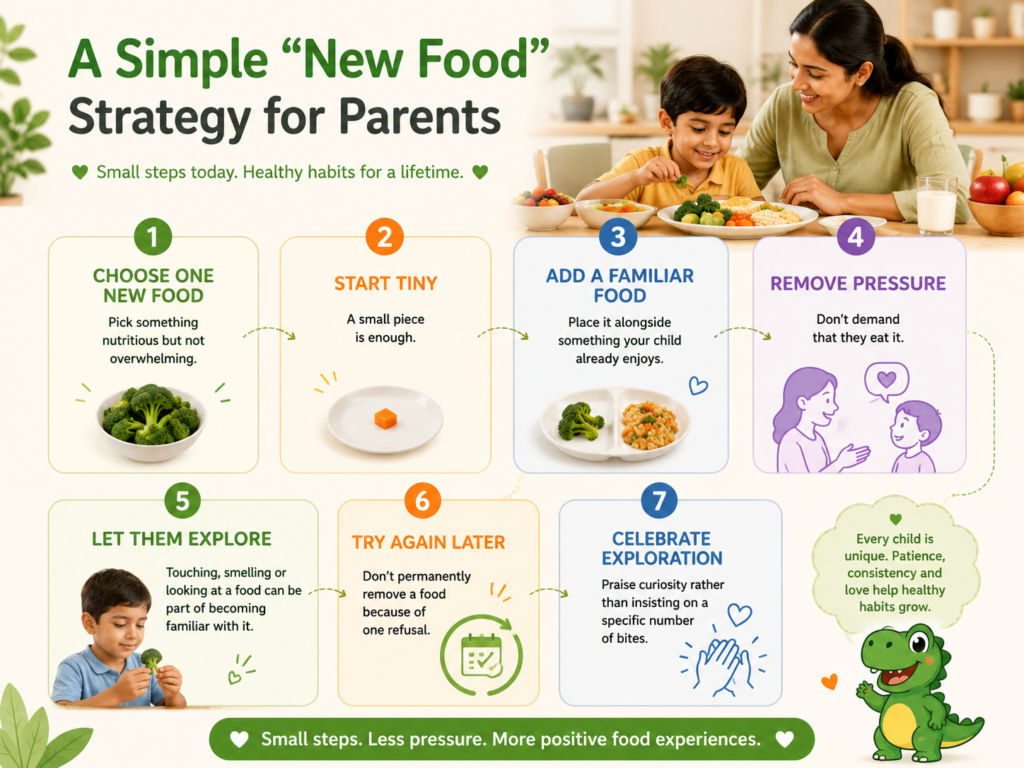
7-step new food strategy for parents to help picky eaters
Example: Turning “I Don’t Eat Vegetables” Into Gradual Exposure
Instead of immediately expecting a child to eat a full serving of vegetables:
Day 1: See the vegetable, Identify the colour, Like C for Carrot
↓
Day 2: Touch it, feel the texture of Carrot, Let the child grasp the carrot
↓
Day 3: Smell it and ask child to say out loud the colour of Carrot
↓
Day 4: Have a tiny portion on the plate, may be in star shape or moon shape
↓
Day 5: Parents should taste it in front of kid and invite the child to imitate
↓
Later: Try it differently
Progress may not be linear. That’s okay. The goal is to gradually make unfamiliar foods familiar and less intimidating. Learn how to get a picky eater to try new foods with patience, positive mealtimes, and simple step-by-step strategies that make new foods feel familiar.
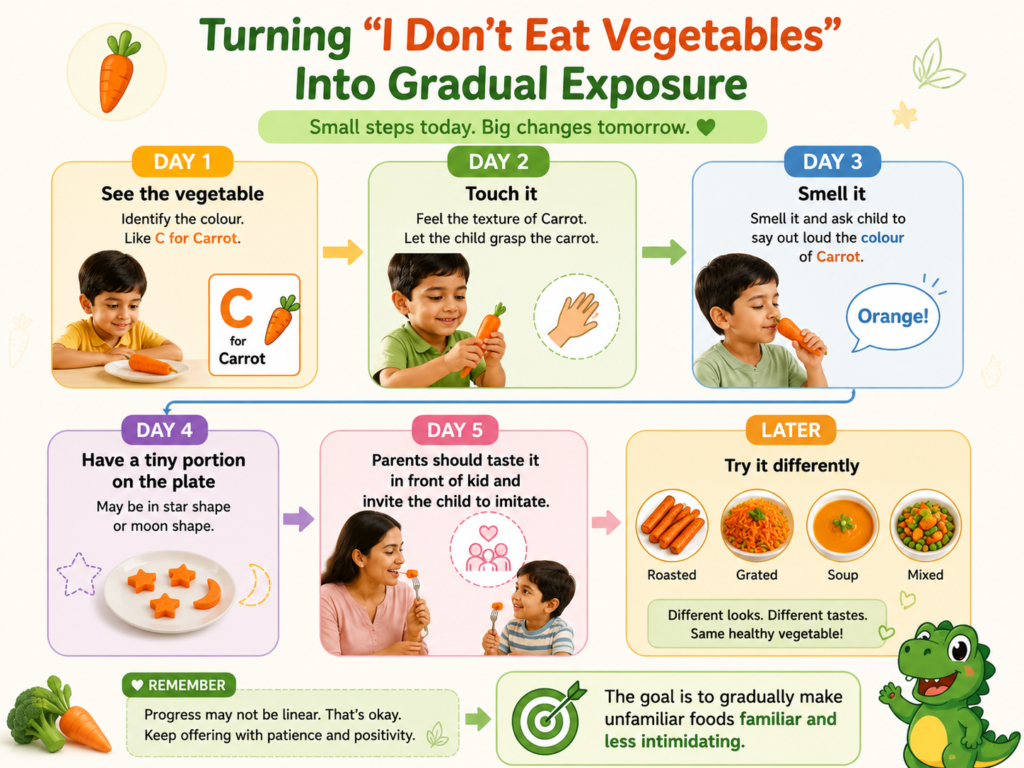
Flowchart showing a gradual exposure strategy for picky eaters
When Should Parents Be Concerned?
Picky eating is common, but extremely restricted eating deserves attention. Consider speaking with your child’s Paediatrician or a qualified dietitian if you notice concerns such as:
- Poor growth or unexpected weight loss
- Very limited food variety
- Avoidance of entire food groups
- Difficulty chewing or swallowing
- Frequent coughing or choking while eating
- Significant distress around meals
- Strong sensory reactions to food
- Persistent feeding difficulties
- Concerns about whether the child is meeting nutritional needs
Some children may need more specialised assessment rather than simply being described as “picky eaters.”
What Parents Should Remember
There is no need to make every meal perfect. A child’s eating pattern should be considered over time rather than judged by a single meal or single day. NHS guidance similarly recommends looking at what a child eats over a week rather than worrying about every individual meal. The most helpful approach is usually:
Offer variety.
Keep meals positive.
Avoid pressure.
Model healthy eating.
Give children opportunities to explore.
Keep trying.
Small steps can eventually lead to a much wider range of accepted foods.
Practical Parent Checklist
Before your next meal, ask yourself:
☐ Have I offered at least one food my child already accepts?
☐ Have I included a nutritious new or less familiar food?
☐ Did I keep the portion small?
☐ Have I avoided pressure?
☐ Did I model eating the food myself?
☐ Have I kept the mealtime positive?
☐ Am I providing my child with opportunities to explore new foods?
If you can answer “yes” to most of these, you’re already creating a supportive environment for food exploration.
Final Takeaway
Getting a picky eater to try new foods isn’t about forcing them to eat.
It’s about creating repeated opportunities for children to see, smell, touch and eventually taste different foods in a calm environment.
Be patient, keep offering nutritious choices, involve children in food preparation when appropriate, and remember that progress can happen gradually.
If you’re concerned about your child’s growth, nutrition, feeding skills or extremely limited diet, speak with their Pediatrician or a qualified nutrition professional.
Explore More From Gumzy
Read practical guidance on DHA for Brain Health in Kids?







Add comment