

Best Multivitamin Gummies for Kids in India: What Every Parent Should Check Before Buying
If you’ve ever stood in front of a pharmacy shelf — or scrolled through forty browser tabs at 11 PM — trying to figure out which multivitamin gummy is actually good for your child, you’re not alone. Every bottle promises “complete nutrition.” Every brand claims kids “love the taste.” And somehow, none of them tell you what you really want to know: does my child even need this, and if so, how do I pick one that isn’t just candy in disguise? This guide answers exactly that. No fluff, no fear-mongering — just what 15 minutes of honest reading can teach you about choosing the best multivitamin gummies for kids in India.
Why Indian Kids Often Need a Multivitamin (The Nutritional Gap Data)
Let’s start with the uncomfortable truth. India’s national health surveys have repeatedly found that a large share of children under five are anaemic, and micronutrient deficiencies — iron, vitamin D, zinc, B12 — remain widespread even in well-fed, middle-class households [cite NFHS-5].
How is that possible when your child eats ghar ka khana every day?
A few reasons, and none of them are your fault:
- Modern diets have changed. Polished rice and refined atta lose much of their natural mineral content. Vegetables travel longer and sit in cold storage. Even a “balanced” plate today often carries fewer micronutrients than the same plate did a generation ago.
- Vegetarian households face specific gaps. Vitamin B12 is found almost exclusively in animal foods. Iron from plant sources (non-heme iron) absorbs poorly. And DHA, the omega-3 your child’s brain is literally built from, barely exists outside fish.
- Kids are kids. The average Indian child between two and ten goes through phases of refusing dal, hiding sabzi under the roti, and surviving on what seems like air and Maggi. Picky eating is developmentally normal — but it leaves real nutritional gaps during the exact years when growth, immunity, and brain development demand the most.
A daily multivitamin doesn’t replace food. Think of it as a safety net under the trapeze — your child’s diet is still the main act, but the net catches what falls through.
The 10 Nutrients That Actually Matter for Children
Marketing labels love long ingredient lists. But paediatric nutrition research keeps pointing back to a core group of nutrients that do the heavy lifting in a growing body:
- Vitamin D — bone development and immune function. Despite our sunshine, deficiency is remarkably common in Indian children.
- Vitamin C — immunity, iron absorption, and tissue repair. Water-soluble, so kids need it daily.
- Vitamin A — vision, skin, and the immune system’s first line of defence.
- B-Complex (especially B12 and Folate/B9) — energy metabolism and red blood cell formation. Critical for vegetarian families.
- Zinc — immunity, appetite, and growth. Low zinc often shows up as a child who “just doesn’t feel like eating,” which then worsens the deficiency. A frustrating cycle.
- Iron — oxygen transport, energy, and concentration. (Note: most gummies contain little or no iron for safety reasons — more on that below.)
- Iodine — thyroid function and cognitive development.
- Magnesium — muscle function, sleep quality, and hundreds of enzymatic processes.
- Vitamin E — an antioxidant that protects growing cells.
- DHA (Omega-3) — usually a separate supplement, but worth mentioning because it’s the most under-consumed brain nutrient in vegetarian Indian diets.
When you compare brands, don’t count how many ingredients a gummy has. Check whether it covers these essentials at meaningful percentages of the Recommended Dietary Allowance (RDA) for your child’s age.
Gummies vs Syrups vs Tablets: Absorption & Compliance
Here’s a secret nutritionists will admit over chai: the best supplement format is the one your child will actually take every day.
Tablets are cheap and precisely dosed, but they’re a choking hazard for children under six and a daily battle for everyone else.
Syrups have been the Indian default for decades. They work, but they often taste medicinal, can stain teeth (iron syrups especially), and dosing with that tiny measuring cup at 7 AM on a school day is its own adventure.
Gummies win on one metric that quietly matters more than all others: compliance. A vitamin your child asks for is a vitamin that gets taken 30 days a month, not 12. Modern pectin-based gummies (more on pectin below) also hold up well in Indian heat and absorb efficiently because they’re chewed — digestion starts in the mouth.
The honest limitation? Gummies have a dose ceiling. You can’t pack therapeutic-level iron or calcium into a small chewable. For everyday nutritional maintenance, they’re excellent. For treating a diagnosed deficiency, your paediatrician may prescribe something stronger alongside.
How to Read a Gummy Label (Sugar, Gelatin, Dosage, Fillers)
This is where good brands separate from candy-with-a-health-halo. Flip the bottle and check four things:
- The sugar story. Some gummies carry 3–4 grams of added sugar each — multiply by daily use and you’ve added a small dessert to your child’s routine. Look for “no added sugar” or naturally sweetened options, and check for tooth-friendly sweeteners.
- Gelatin vs pectin. Traditional gummies use gelatin, an animal-derived gelling agent — a dealbreaker for vegetarian families, and often undisclosed in fine print. Pectin (from fruit) is 100% plant-based, suits every dietary preference, and handles heat better, which matters when your courier van sits in 42°C traffic.
- Actual dosage per gummy. A label listing 20 nutrients at trace amounts is window dressing. Check the per-gummy quantity against your child’s RDA. Meaningful coverage of 10 nutrients beats homeopathic dustings of 25.
- Fillers, colours, and “proprietary blends.” Artificial colours and vague blends that hide exact quantities are yellow flags. Transparent labels are a sign the brand expects scrutiny — and welcomes it.
Red Flags: What to Avoid in Kids’ Vitamins
A quick checklist of warning signs, from years of watching this industry:
- Medical-sounding promises. Any gummy claiming to “cure” deficiencies, “boost IQ,” or “guarantee height growth” is overreaching. Supplements support health; they don’t perform miracles, and brands that pretend otherwise cut corners elsewhere too.
- No manufacturing credentials. Look for FSSAI licensing and manufacturing in certified (ideally USFDA-approved) facilities. If the label doesn’t say where it’s made, ask why.
- Adult formulas marketed to kids. Children’s RDAs are not “half an adult dose.” A proper kids’ gummy is formulated for paediatric needs from scratch.
- Mega-doses. More isn’t better with fat-soluble vitamins (A, D, E, K), which accumulate in the body. A good children’s formula stays within safe paediatric ranges deliberately.
How We Formulate at Gumzy (A Brief, Transparent Section)
Since you’re reading this on our blog, fairness demands transparency about our own choices — judge us by the same checklist above.
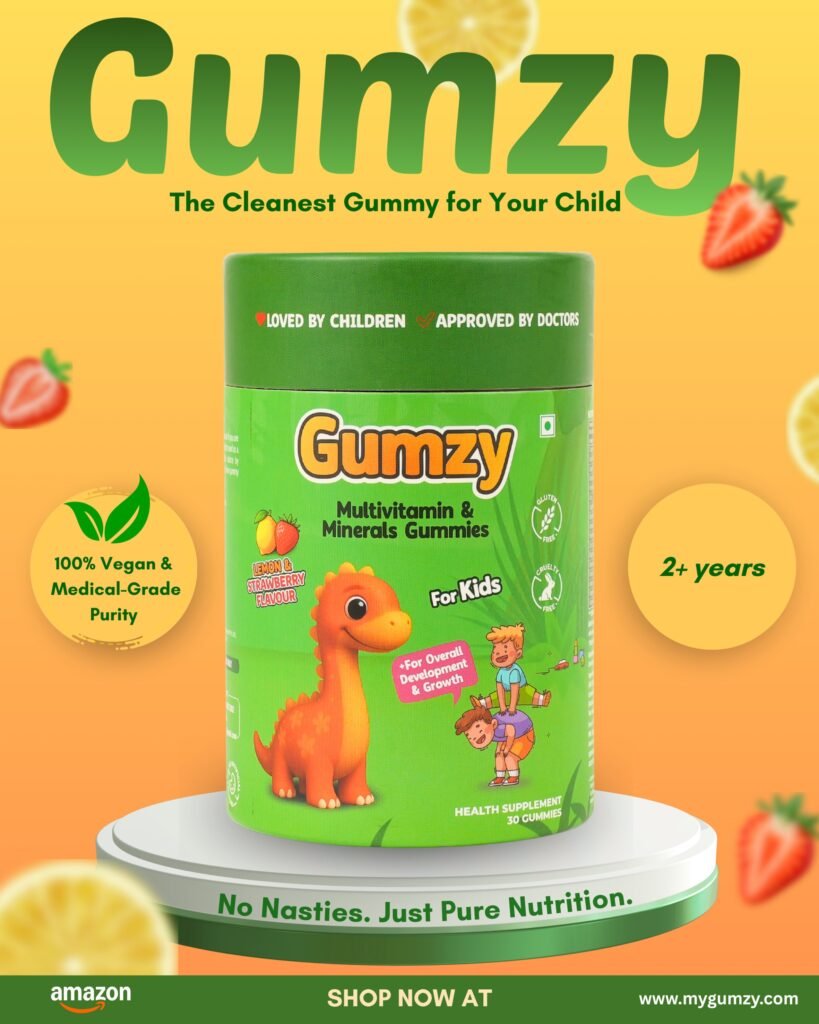
Our Kids Complete Multivitamin Gummies are built on a vegan pectin base (no gelatin, ever), cover 10+ essential vitamins and minerals at child-appropriate RDA levels, skip artificial nasties, and are manufactured in a USFDA-approved facility. The lemon-strawberry flavour exists for one strategic reason: a gummy your child genuinely enjoys is the only gummy that delivers its nutrients 365 days a year.
That’s our approach. Whether you choose us or another brand, use the label checklist — it works on every bottle, including ours.
Age-Wise Dosage Guide (2–4, 5–8, 9–12)
General guidance for gummy multivitamins (always defer to the specific product label and your paediatrician):
- Ages 2–4: Typically one gummy daily, ideally supervised and chewed thoroughly. Never give gummies to children under two without medical advice.
- Ages 5–8: One gummy daily is standard; some formulas allow two. Pair with breakfast to build the habit.
- Ages 9–12: Follow label guidance — growing pre-teens may take a slightly higher serving depending on the formula.
Two non-negotiable safety rules: store the bottle out of reach (gummies look like sweets, and children will treat them as such), and never frame vitamins as candy rewards — that framing is exactly how accidental overconsumption happens.
When to See a Paediatrician Instead
A daily multivitamin is a safety net, not a substitute for medical care. Skip the supplement aisle and book a doctor’s appointment if your child shows:
- Persistent fatigue, paleness, or breathlessness (possible anaemia — needs testing, not guessing)
- Significantly delayed growth or weight loss
- Frequent infections that keep returning
- Extreme food refusal lasting months, or a shrinking list of accepted foods
Blood tests (haemoglobin, ferritin, vitamin D, B12) cost a few hundred rupees and replace months of uncertainty with answers. Supplements work best when you know which gap you’re filling.
Frequently Asked Questions
Are gummy vitamins as effective as tablets?
For everyday nutritional maintenance, yes — well-formulated gummies deliver comparable absorption, and chewing actually kick-starts digestion. For treating diagnosed deficiencies requiring high therapeutic doses, tablets or prescribed syrups may be necessary. Effectiveness also depends on consistency, where gummies usually win.
From what age can kids take gummies?
Most children’s gummies are designed for ages 2 and up, once a child can chew safely. Under two, consult your paediatrician before any supplement.
Can a child overdose on gummy vitamins?
Yes — which is why storage matters. Eating many gummies at once can push fat-soluble vitamins (and iron, if present) to harmful levels. Keep bottles locked away and stick to label dosage. If a child consumes a large quantity, contact a doctor immediately.
Do kids on a balanced diet still need multivitamins?
Not always. A genuinely varied diet may cover everything. But “balanced on paper” and “balanced as actually eaten by a six-year-old” are different documents — and vegetarian diets commonly fall short on B12, iron, and DHA regardless of variety. When in doubt, test, then supplement.
The Bottom Line
Choosing the best multivitamin gummies for kids in India comes down to four checks: pectin over gelatin, real RDA-level dosing, no added-sugar tricks, and certified manufacturing. Get those right, and you’ve turned a daily struggle into a two-second habit your child actually looks forward to.







Add comment