
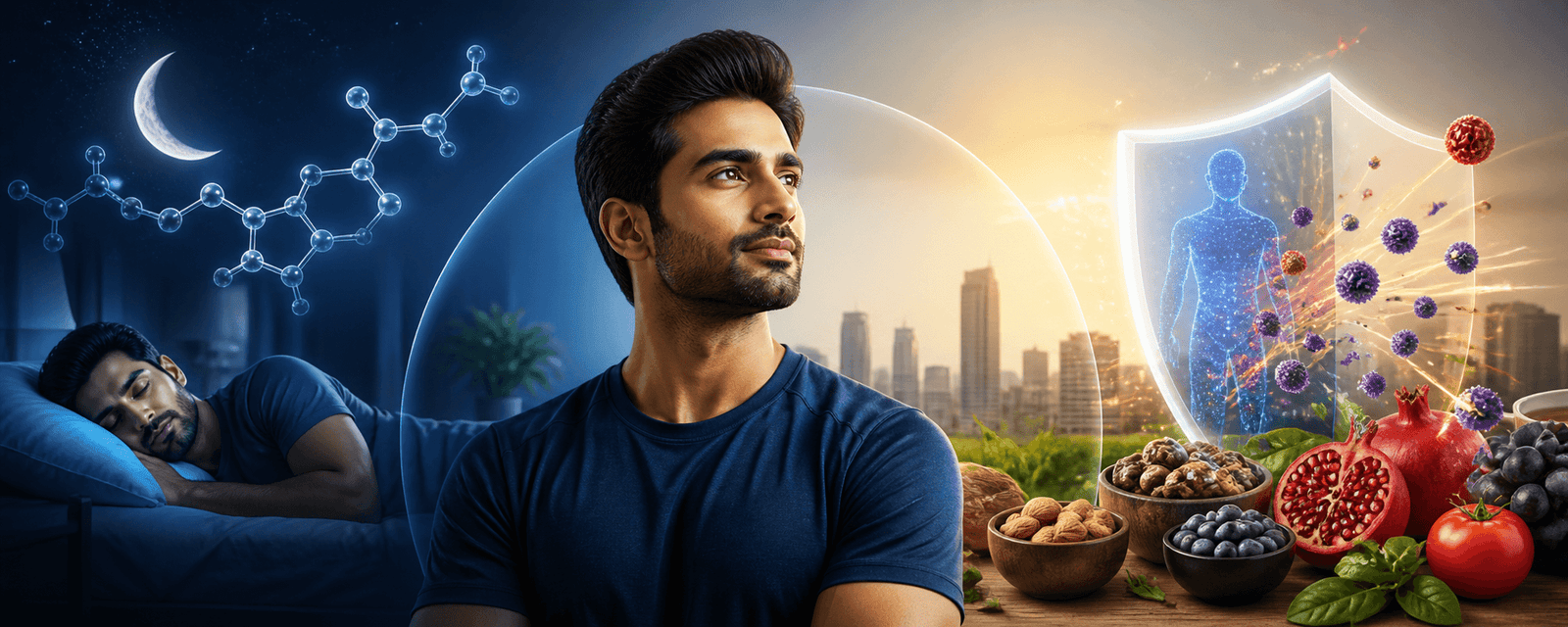
Beyond Sleep: The Hidden Antioxidant Power of Melatonin for the Modern Indian Men
For the modern Indian men, crossing the age of 45 often comes with a shift in daily realities. Between managing executive responsibilities, navigating family obligations, and living in fast-paced urban environments, the body’s resilience is constantly tested. While much of the conversation around health at this age centers on heart disease, blood sugar, and stress management, a critical biological protector is often overlooked: Melatonin.
Most of us know melatonin simply as the “sleep hormone.” But clinically, this ancient molecule is one of the most powerful, multifaceted biological signals in the human body.
Here is why looking beyond sleep and understanding the systemic, antioxidant power of melatonin is crucial for men optimizing their health into their 50s and beyond.
The 45+ Drop: Why Your Body Needs Reinforcements?
Melatonin is synthesized in the brain’s pineal gland and regulated by our exposure to light and dark. However, our natural production of this vital hormone does not remain constant throughout our lives.
Total melatonin levels peak just before puberty and then decline progressively as we age. By the time a man reaches his senior years, his nocturnal peak melatonin concentration can drop to less than one-third of what it was in his youth! This age-related decline, compounded by the chronic stress and artificial blue light exposure typical of modern Indian corporate life, deprives the body of a critical recovery tool right when it needs it most.
The Master Antioxidant: Protecting Your Cells from the Inside Out
The most profound, yet least discussed, role of endogenous melatonin is its function as a potent antioxidant. As we age, our bodies accumulate oxidative stress from environmental toxins, poor diets, and high-pressure lifestyles. This results in the production of free radicals, which damage cells and accelerate aging.
- Deep Cellular Penetration: Unlike many other antioxidants, melatonin has the unique ability to readily penetrate cellular membranes.
- Mitochondrial Defense: Once inside the cell, it acts as a free radical scavenger, providing direct antioxidant protection to the mitochondria (the powerhouse of the cell) and safeguarding our DNA from damage.
Protecting Male Vitality and Reproductive Health
One of the most significant areas where oxidative stress takes a toll is on male reproductive health and vitality. It is widely accepted that oxidative stress has detrimental effects on male fertility. For men over 45, the daily accumulation of Reactive Oxygen and Nitrogen Species (RONS) can severely degrade reproductive cells.
These damaging free radicals are heavily driven by modern lifestyle and environmental factors, including:
- Urban and Lifestyle Stressors: Factors such as cigarette smoking, alcohol consumption, obesity, and exposure to electromagnetic radiation significantly increase RONS generation in the body.
- Mitochondrial Metabolism: While mitochondria power our cells, their natural metabolic processes can also be a significant source of reactive oxygen if not properly neutralized by antioxidants.
This is where melatonin steps in as a targeted biological defense. Recent clinical reviews demonstrate that melatonin actively ameliorates oxidative stress within reproductive cells. By neutralizing RONS, melatonin supplementation has been shown to successfully improve overall semen parameters and can preserve or restore reproductive cell quality even under highly stressful conditions. It works to maintain hormonal stability and protect the functional integrity of male reproductive cells from rapid oxidative aging.
Systemic Health: Heart, Metabolism, and Immunity
Because melatonin receptors are distributed broadly throughout the central nervous system and peripheral tissues, its protective benefits extend far beyond reproductive and neural health:
- Cardiovascular Protection & Blood Pressure: Melatonin secretion at night is actively involved in reducing blood pressure. It promotes endothelium-dependent vasodilation (the relaxation of blood vessels) and provides broad cardioprotective effects.
- Metabolic Balance: Emerging clinical evidence indicates that melatonin signaling plays a key role in regulating glucose levels, energy metabolism, and even fat accumulation, working alongside other regulators like insulin.
- Immune System Modulation: Melatonin is deeply involved in regulating both our innate and adaptive immunity, offering anti-inflammatory actions that help the body recover from daily physiological stress.
Rethinking Supplementation: The Clinical Standard
When natural levels drop, clinical supplementation becomes a valuable tool. However, optimizing health requires more than just picking up any standard supplement.
For maximum efficacy, particularly when addressing executive fatigue, cellular aging, and reproductive vitality, the focus must be on high-bioavailability, clean formulations. Choosing easy-to-digest gummy that ensure molecular stability and utilizing clinically validated doses allows the body to effectively absorb and utilize the supplement. This ensures that the active ingredients can seamlessly cross cellular barriers to neutralize free radicals, support metabolic pathways, and regulate the nervous system safely.
Melatonin is not just a mechanism for a good night’s rest; it is a foundational pillar of healthy aging, cellular defense, and sustained vitality. By respecting the body’s natural circadian rhythms and supporting it with science-backed, high-quality nutrition, you are investing in a longer, sharper, and healthier life.







Add comment